Affordable Marketing Options for Small Businesses That Actually Work in 2026
Published: April 14, 2026 Updated: June 09, 2026
Short answer: You don't need a big budget to market well — you need to show up in the right place at the right time.
Running a small business right now isn't easy. Costs keep going up, competition keeps growing, and it feels like you're expected to "campaign" like a much bigger company.
Reality check: Most people aren't trying to compete with big corporations and their Superbowl money — but they also don't want to get lost next to a bunch of low-effort or forgettable products either.
The goal is simple: stand out in a way that actually reflects what you've built, without having to outspend everyone else.
Simple? Yes...? Easy? God NO!
Focus on where you show up
A lot of marketing advice still pushes scale — reach more people, spend more, post everywhere.
But for small businesses, that usually just burns time and money.
What matters more is where you show up.
Being in the right place, around the right people, can often do more than reaching a huge audience that doesn't care — or worse, actively ignores advertising.
The internet is crowded. Attention is limited. Relevance matters.
It's more about attention than budget now
You've probably seen this yourself — one post, one mention, or one recommendation can do more than weeks of effort.
That's not random.
And the truth is, small business owners are often better at spotting what might work than any generic campaign. You know your product. You know your audience. You know what just clicks.
The best opportunities don't just attract attention — they attract the right attention.
It's less about how much you spend and more about whether the people seeing your product actually care.
Context matters more than people admit
A lot of successful marketing comes down to context.
The same product can perform very differently depending on where it appears, who is talking about it, and what conversation surrounds it.
A recommendation from a trusted creator often carries more weight than a banner ad.
A mention inside a community can outperform a much larger campaign aimed at a general audience.
People don't discover things in a vacuum. They discover them through creators they follow, communities they participate in, publications they trust, and interests they already care about.
The strongest opportunities are usually the ones where people can immediately understand why a product belongs there.
Not all attention is equal
Marketing reports often focus on numbers.
More impressions.
More clicks.
More traffic.
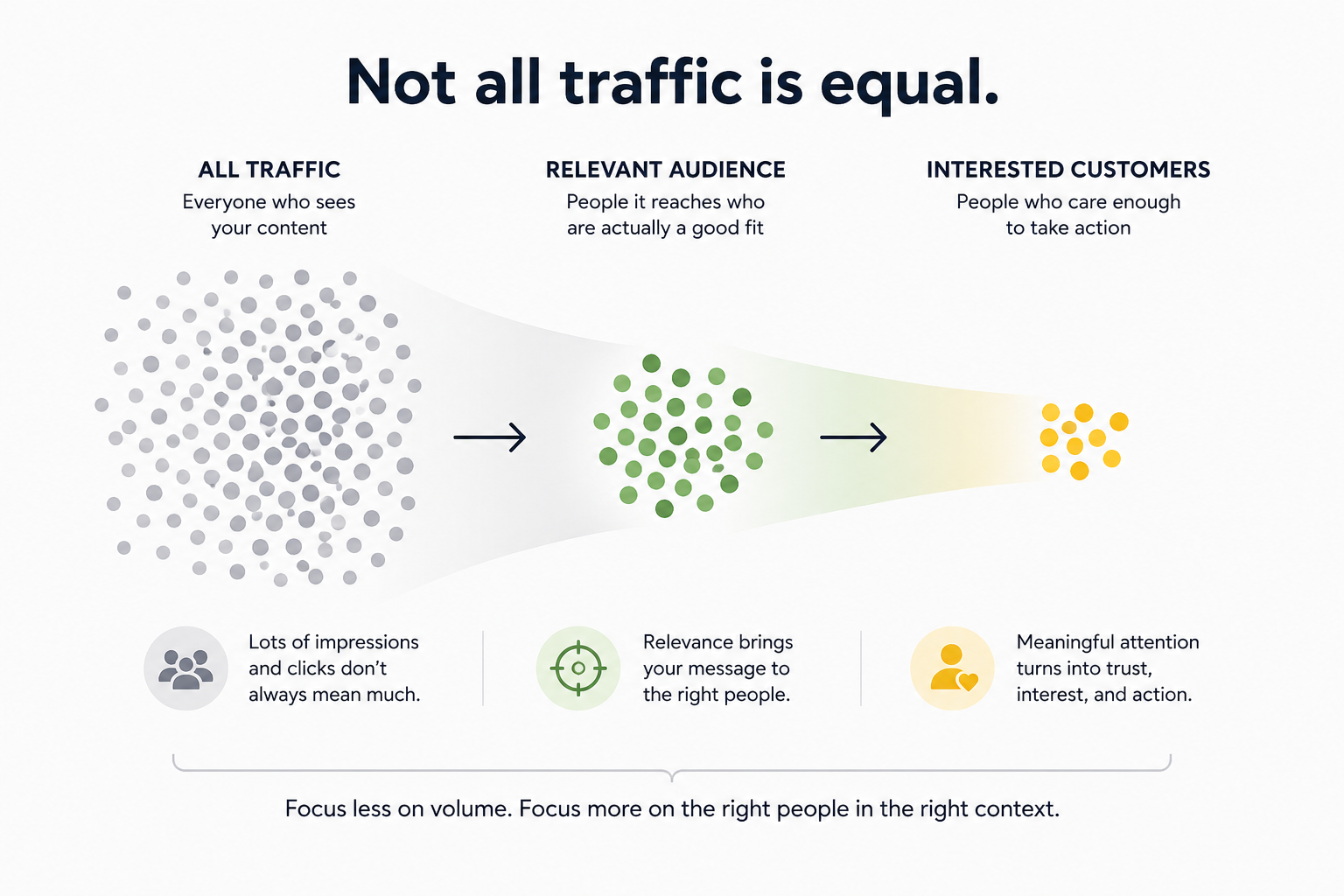
But not all attention carries the same value.
A visitor who discovers your product through a trusted creator, community, or recommendation is very different from a bot, click-farm visitor, idle tab impression, accidental click, or someone who leaves immediately.
All of those interactions may appear in a report. They don't necessarily represent genuine interest.
For small businesses, the more useful question is often not:
How many people saw this?
It's:
How many of the right people saw this?
A hundred genuinely interested people can be worth far more than ten thousand passive impressions.
Why a lot of traditional marketing doesn't fit
Influencer campaigns and agency setups usually require upfront commitments, coordination, and fixed budgets.
That's a lot to commit when you're not even sure what's going to work.
On top of that, agency fees and campaign costs can eat into money that could have gone into improving the product itself.
Many traditional campaigns buy visibility. They don't necessarily help a business become part of the communities and conversations that drive long-term interest.
A lot of small teams are starting to think the same thing: marketing shouldn't be the thing that holds a good product back.
Even with support, the hard part is still attention
Take New York City's small business programs for example — there's been a push to provide more funding and support for local businesses.
That helps.
But it doesn't solve the main problem: getting people to actually see and care about what you're doing.
Money helps you run the business.
It doesn't guarantee attention.
A different way to approach it
Instead of putting everything into one big campaign, it can make more sense to stay flexible and act on opportunities as they appear.
That's where Boom•Clap comes in.
Boom•Clap helps businesses discover creators, communities, and conversations that may be a good fit for their products.
Rather than focusing exclusively on audience size or advertising inventory, it focuses on finding opportunities where a product can naturally become part of an existing discussion.
People don't discover products in isolation. They discover them through creators they follow, communities they participate in, publications they trust, and interests they already care about.
When a product genuinely fits the surrounding environment, marketing feels less like interruption and more like participation.
Good marketing is not only about visibility.
It's also about becoming part of something larger than yourself.
The strongest brands are often the ones that become part of the communities, interests, and culture surrounding them.
Sometimes a niche creator, independent publication, local community, or growing conversation can generate more meaningful interest than a much larger advertising campaign.
For small businesses, that creates an opportunity to compete through relevance, originality, and authenticity rather than budget alone.
Final thoughts
You don't need to outspend bigger companies to stand out.
You just need to understand where your product fits, which communities are most likely to appreciate it, and be ready when the right opportunity appears.
The businesses people remember are rarely the ones that appeared everywhere. They're the ones that became part of the conversations, communities, and culture surrounding them.
Marketing on a budget isn't about shouting louder than everyone else.
It's about showing up where you belong.