A New and Affordable Way to Promote Your Art and Reach the Right Audience
Published: May 13, 2026 Updated: June 09, 2026
Short answer: Promoting your art is less about constantly posting everywhere, and more about reaching the right people in the right context at the right moment.
A lot of artists struggle with the same thing: creating the work is one challenge, but getting people to actually notice it is another.
And honestly, most advice online is exhausting.
Post constantly. Chase trends. Learn algorithms. Upload short-form videos. Stay active on every platform. Engage nonstop.
For many independent artists, promotion slowly turns into a second full-time job — and even then, there is no guarantee the work will actually reach the people who would genuinely connect with it.

Apollo and Daphne (1622–1625), by Gian Lorenzo Bernini. Photo by Architas, licensed under CC BY-SA 4.0 via Wikimedia Commons.
Most artists have already tried the obvious things
By the time many artists start searching for ways to promote their own work, they have usually already tried most of the obvious options.
Posting constantly on social media. Sharing work in Reddit self-promotion threads. Uploading to SoundCloud and experimenting with paid promotion. Messaging pages and curators. Joining Discord communities. Running small ads that disappear after a few clicks.
Sometimes something briefly works. Most of the time, it feels inconsistent and difficult to sustain.
That is where a lot of the frustration comes from.
Many artists are already putting real effort into promotion, but still struggle to consistently reach the people who would genuinely connect with their work.
The problem is not just effort any more
It is about attention.
Or perhaps more accurately, it is about finding people who genuinely care.
Most artists are not chasing impressions for the sake of impressions. They are looking for listeners, readers, viewers, attendees, collectors, supporters, and fans.
Because at the end of the day, a hundred genuine fans are usually worth more than ten thousand people who barely remember seeing your work.
In this age of information overload and collapsing attention spans, it has become incredibly difficult to hold people’s attention without the supercharge of sensationalism, the absurdity of engagement bait, or a colossal marketing budget large enough to pay Sydney Sweeney 20 million dollars to hold your new album for seven seconds.
That is the reality we all have to face and accept — even with genuine effort, meaningful work still gets buried because, unfortunately, depth and nuance are often not rewarded by the way today’s Internet works.
So the real question becomes: how do artists actually earn attention in environments designed to overwhelm it?
Context matters more than volume
A lot of conventional marketing advice still pushes scale: reach more people, spend more money, post more often.
But for artists, context usually matters more than volume.
The right audience, mood, or conversation can do far more than massive reach from people who were never going to be interested in the work to begin with.
When a piece appears naturally in a moment where it already fits the surrounding atmosphere or conversation, engagement feels much more organic.
Sometimes one meaningful moment of visibility can outperform weeks of forced promotion.
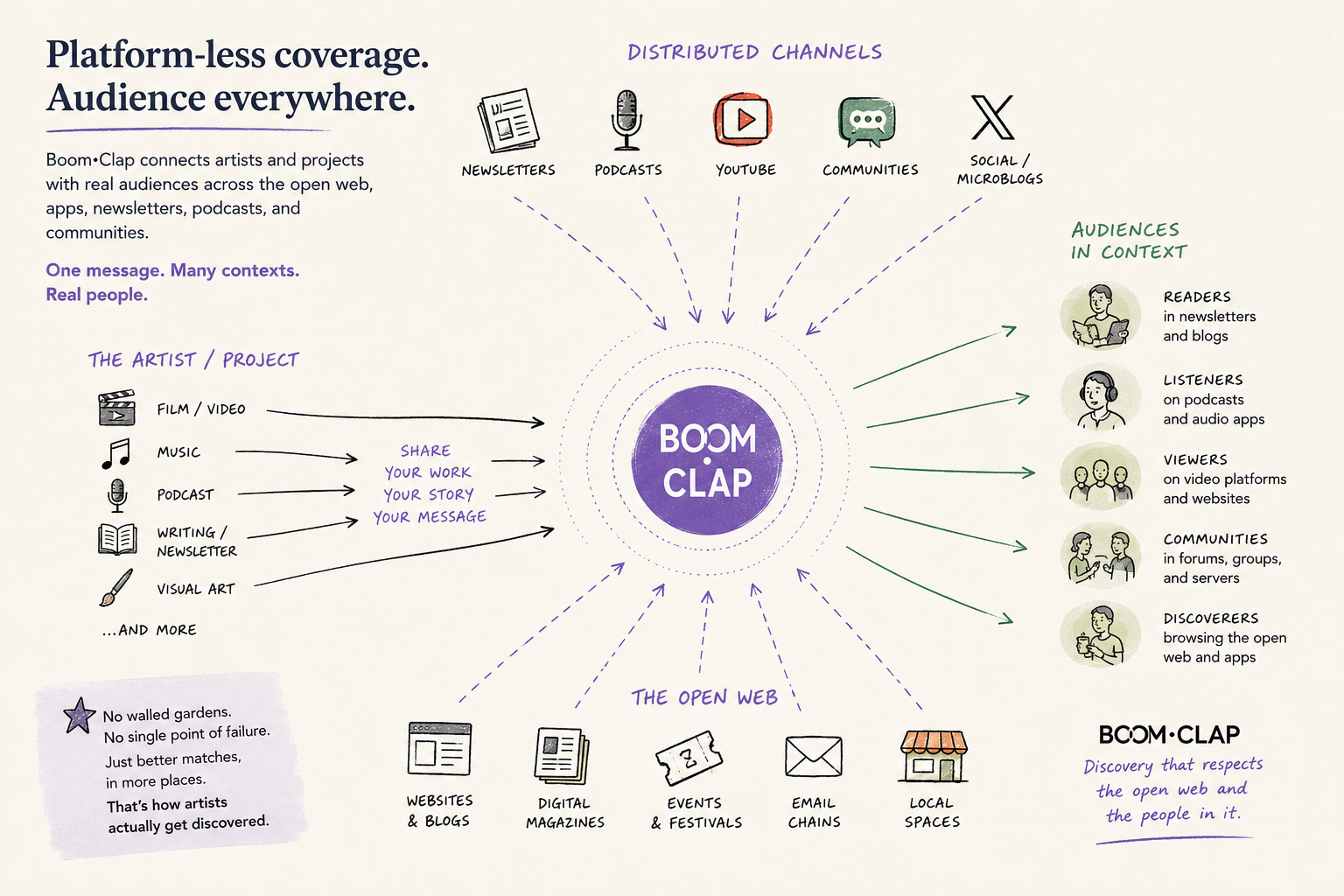
Your audience probably does not live on one platform
Another thing artists learn pretty quickly is that audiences do not magically exist inside platforms.
The same person might discover a musician through a YouTube video, hear them mentioned on a podcast, subscribe to a newsletter, follow them on social media, and eventually attend a live show.
A documentary viewer might first encounter a review, then a discussion thread, then a trailer, and finally the film itself.
Discovery rarely follows a straight line.
That is why relying entirely on a single platform can feel so frustrating. The audience is usually scattered across communities, publications, creators, podcasts, newsletters, blogs, events, and countless other places connected by shared interests rather than shared software.
Artists are not really looking for platform users.
They are looking for listeners, readers, viewers, attendees, collectors, supporters, and fans — wherever those people happen to be.
A different approach
So what if promotion worked differently?
What if, instead of getting buried underneath everything else, artists could appear closer to the top while attention is still forming around a conversation, trend, or emerging piece of content?
What if, instead of being outbid by prediction markets and their deep pockets, artists are presented to people that crave their daily dose of fresh ideas and Vitamin-Art?
That is part of the idea behind Boom•Clap.
Rather than relying entirely on expensive campaigns or broad targeting, Boom•Clap focuses on culture — helping surface opportunities where creative work may naturally fit, from emerging content to vibrant communities.
The goal is not simply to promote louder.
It is to help artists participate earlier and more naturally in places where their art can be understood and appreciated.
If you are a punk rock band based in Brooklyn, then a trending TikTok tribute clip dedicated to Nirvana could probably bring you more real listeners than standing outside Barclays Center handing out QR codes for eight hours straight.
If you are an independent sculptor, then a viral tweet about two basketball players "Accidental Renaissance"-ing themselves into Bernini's Apollo and Daphne could easily drive more authentic traffic to your work than generic Google Ads ever will.
If you are running a small experimental theater production, then a blog series reimagining A Midsummer Night's Dream through the lens of Park Chan-wook's camerawork could end up bringing you more genuinely interested attendees than weeks of reposting the same flyer into exhausted local Facebook groups.
That is the difference cultured context can make.
Scene from The Handmaiden (2016), directed by Park Chan-wook. GIF shared via Tumblr.
Final thoughts
Promoting art today is not simply about posting more often or shouting louder than everyone else.
More often, it comes down to visibility, context, and discovery — understanding where your work naturally fits and finding ways to place it in front of the people most likely to genuinely connect with it.
For many artists, the challenge is not creating meaningful work.
It is making sure the right people actually get the chance to see it.
The goal is not simply to accumulate views.
It is to find an audience.
And maybe, if you are lucky, a few fans who stick around for years.
So… let's learn more about Boom•Clap?