The Search for Better Website Monetization
New Monetization Opportunities for Your Blog or Website
Published: June 2026
Advertising and affiliate links remain the most common ways to monetize a website, but they are not without challenges. Between ad blockers, banner blindness, and low conversion rates, many publishers are looking for additional revenue opportunities that feel less intrusive and more sustainable.
The old monetization playbook is starting to show its age
For years, website monetization followed a fairly simple formula.
Create content.
Attract visitors.
Put advertisements on pages.
Squeeze in affiliate links.
Get paid, maybe.
The problem is that the internet has changed.
Search engines increasingly answer questions directly through AI summaries and rich results before users ever click through to a website.
Bot traffic continues to muddy analytics and inflate visitor numbers without generating meaningful engagement.
Ad blockers have become commonplace, and modern browsers on both desktop and mobile devices make them easier to install than ever before.
Meanwhile, many readers have simply learned to tune advertisements out.
Even affiliate marketing, while still valuable for many publishers, often depends on a relatively small percentage of visitors ultimately making a purchase.
As a result, publishers frequently find themselves in a frustrating position: producing quality content, attracting genuine visitors, and still struggling to convert that attention into meaningful revenue.
And when revenue does fall short, the typical advice is often more of the same.
Add another ad unit.
Add another banner.
Add another pop-up.
Add another sponsored placement.
Unfortunately, every additional monetization layer risks making the experience worse for the very people the publication exists to serve.
What if monetization did not have to compete with content?
Most monetization systems ask publishers to make a trade-off.
Earn more revenue.
Or maintain a clean user experience.
Rarely both.
But what if there were another option?
What if monetization could happen without covering pages in banners, interrupting articles with pop-ups, or constantly asking visitors to buy something?
What if the opportunity being presented was actually interesting?
A new artist.
A local event.
An independent creator.
A useful service.
A uniqiue invention.
A cause worth discovering.
What if those opportunities were selected because they fit the surrounding environment rather than because they offered the highest bid?
What if visitors could view them as a brief moment of discovery instead of desperate advertising?
And what if publishers could earn revenue from those moments without replacing the advertising, affiliate programs, sponsorships, memberships, or partnerships they already use today?
Rather than competing with existing monetization systems, such an approach could complement them.
Adding another revenue opportunity without requiring publishers to dismantle the infrastructure they already depend on.
Introducing Melody
That idea forms part of the foundation behind Boom•Clap Melody.
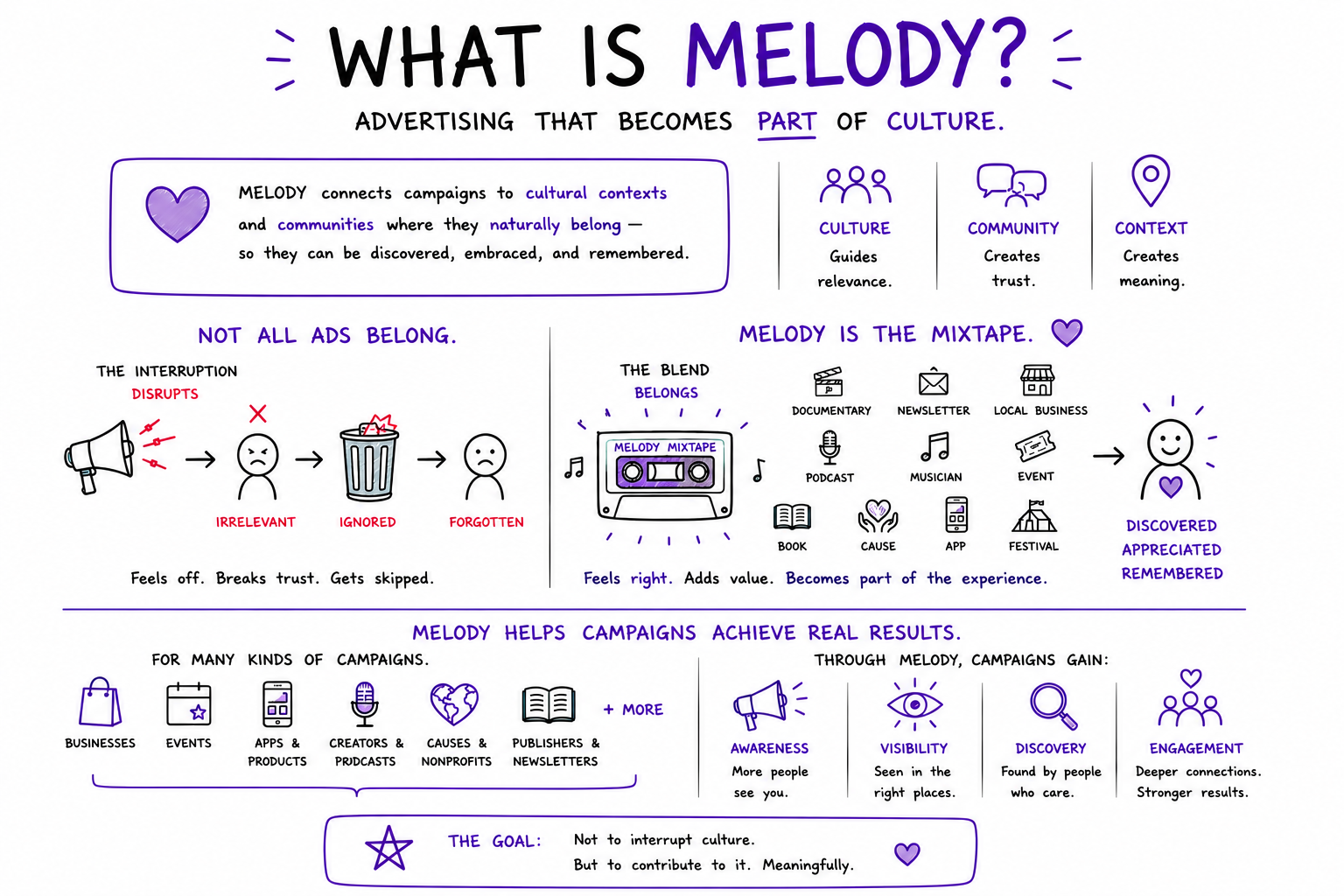
Melody is a contextual circulation system designed to help publishers earn revenue through lightweight discovery experiences that occur during natural transitions that are already taking place.
Rather than interrupting somebody while they are reading an article, watching a video, browsing a gallery, or listening to a podcast, Melody appears when a visitor has already chosen to continue somewhere else.
For example, a visitor clicks a link.
Before reaching the destination, they are briefly presented with a small discovery opportunity curated using information on the page and the destination they are going to.
This might be an artist releasing a new album.
An upcoming cultural event.
An independent publication.
A local business.
A community project.
A nonprofit initiative.
Or another compatible campaign that fits the surrounding context.
After a few seconds, visitors continue to their original destination as expected.
The experience is designed around discovery rather than interruption.
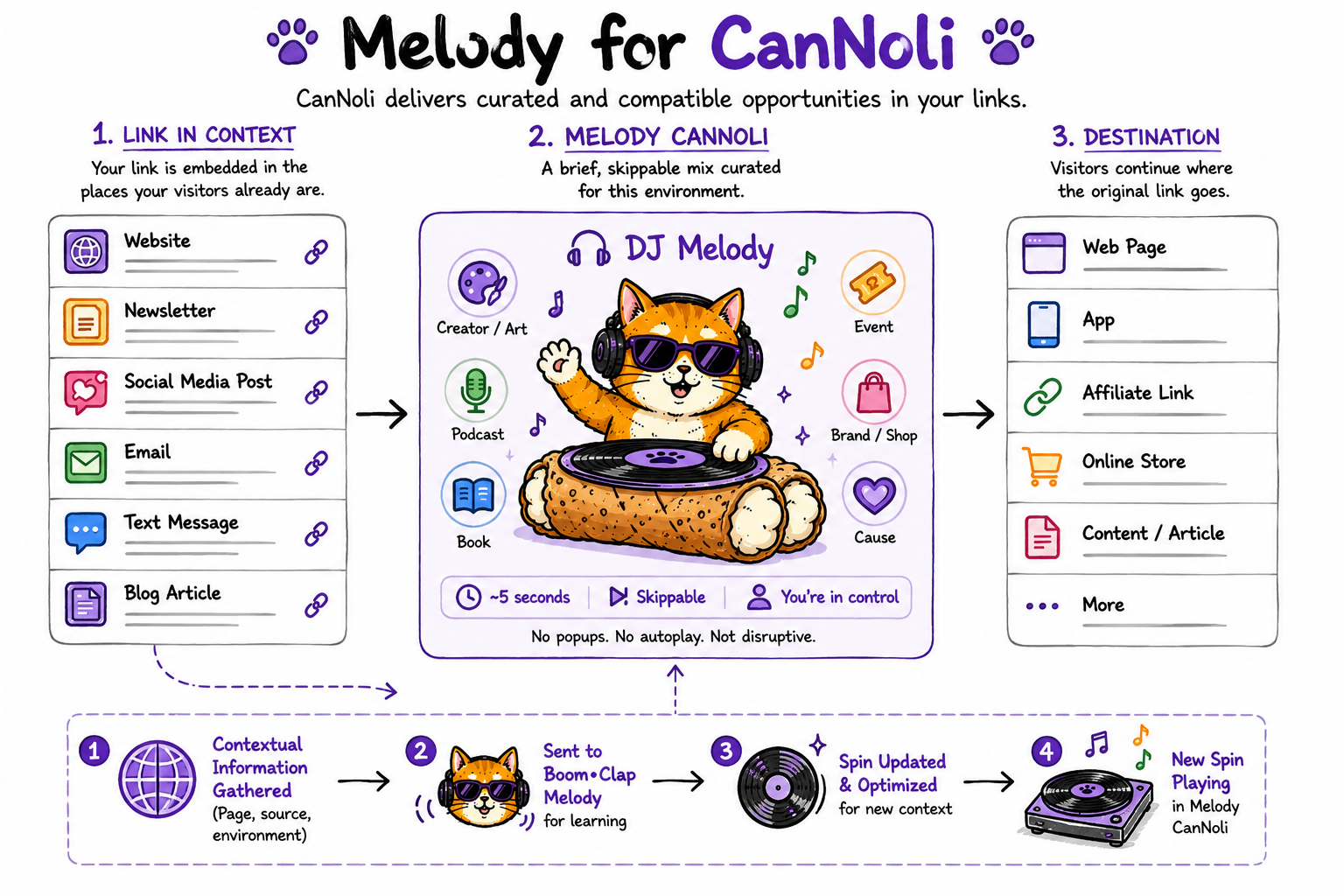
For publishers, Melody can be integrated through Cannoli intermissions or self-hosted environments and may generate revenue through contextual circulation campaigns that participate within compatible Spins.
The goal is not to replace advertising, affiliate marketing, sponsorships, memberships, or subscriptions.
The goal is to provide an additional monetization layer that can coexist alongside them.
Who is Melody designed for?
Melody is generally best suited for publishers who create genuine content and cultivate real audiences.
Independent blogs.
Newsletters.
Community publications.
Creative websites.
Artist collectives.
Podcasts.
Cultural publications.
Local interest sites.
Niche communities.
In other words, publishers who are already helping people discover new ideas, projects, creators, and experiences.
Because at its core, Melody is not simply about monetization.
It is about supporting discovery.
And helping the people who create those environments participate in the value they help generate.
Final thoughts
Advertising and affiliate marketing are not going away any time soon.
For many publishers, they will remain important parts of the monetization mix.
But as the web continues to evolve, publishers are increasingly looking for additional revenue opportunities that respect both their audience and their content.
The future may not belong to a single monetization model.
It may belong to publishers who thoughtfully combine several approaches that work together.
And perhaps, along the way, create a few more opportunities for meaningful discovery too.
So... let's learn more about Melody with Cannoli?
A note for e-commerce websites
Most of this article focuses on publishers, blogs, newsletters, and content-driven websites because that is where Melody tends to feel most natural.
However, e-commerce websites may also find opportunities to participate through selective use on non-transactional internal navigation.
Unlike content publishers, online stores already have a primary monetization model: selling products. For that reason, Melody is generally not intended for checkout flows, cart pages, product purchases, or other high-intent transactional moments.
Instead, it can be deployed on internal navigational paths where visitors are already moving between sections of a website.
For example:
- About Us → Product Catalog
- Brand Story → Collection Page
- Buying Guide → Product Category
- Community Page → Featured Products
- Editorial Content → Store
In these situations, Melody can function as a supplementary discovery layer during a transition that is already taking place, without interfering with the purchasing experience itself.
The goal is not to place an intermission in front of every click. Rather, it is to selectively participate in moments where discovery feels natural and where the user experience remains the first priority.